
The Q1FY24 earnings season has started on a dismal note for corporate India. The early-bird companies' revenue growth has been at a 10-quarter low, while the combined earnings of non-BFSI (banking, financial services, and insurance) companies seem to have hit the ceiling. The numbers suggest corporate India is entirely dependent on BFSI companies and the IT services sector to drive growth in revenue and profit while other sectors are showing signs of stagnation.

Fuelled by the $57.8-billion merger of HDFC twins (HDFC Ltd and HDFC Bank), M&A (merger and acquisition) transactions in India touched a record high of $124.2 billion in the first half of 2022-23. Bankers said with several transactions, including the government's stake sale in IDBI Bank and Hindustan Zinc in the pipeline, the ongoing financial year will end up as the best year for M&A activity in the country. Apart from the HDFC transaction, the $6.5-billion acquisition of Holcim stake by the Adani family and L&T's $3.2-billion acquisition of Mindtree added to the record transactions in the first half of FY23.

A day after the finance ministry cut import duties on a variety of product categories, top manufacturers of zinc -- Hindustan Zinc and Binani Zinc -- slashed prices.
The Cabinet Committee on Economic Affairs on Thursday referred the issue of selling the government's residual 30 per cent stake in Hindustan Zinc Ltd to a Group of Ministers for a final decision.

Prime Minister Narendra Modi, who won a landslide election victory in May largely on a promise of economic growth, is expected to speed up divestments to bolster revenue generation.

10 high dividend paying stocks across sectors that are expected to maintain or even increase their pay-outs in FY23 thanks to faster earnings growth in the last four quarters.

Better living conditions must be an integral part of all political campaigns. But this will only happen if the public pressures the political class to understand the irreversibility of climate change and make the environment a crucial part of their manifestos.

'The force of reforms. The force of investment. The force of formalisation. The force of digital and green technology. And the force of youth and entrepreneurship. I am convinced that these 5 forces will propel India's rise over the next several decades,' predicts Kumar Mangalam Birla, chairman, Aditya Birla group.

Corporate India continues to be generous in rewarding its shareholders with big dividend payouts. This is especially true for shareholders of companies such as Tata Consultancy Services (TCS), Hindustan Zinc (HZL), and Coal India (CIL) which are seen as cash cows of large business groups and the government. Boosted by a big payout by these three companies, the combined equity dividend payout by listed companies was up 38 per cent year-on-year (YoY) to a record high of Rs 2.27 trillion in 2022-23 (FY23), compared with Rs 1.65 trillion in 2021-22 (FY22).

Quarterly earnings and global cues will be the major sentiment driver for the equity market this week, according to analysts. Of late, Benchmark indices have been on a record-breaking run. "Quarterly results will dictate market sentiment and will be the talk of this week as they pick up the pace. "D-Street will be all ears to any management insights to forecast the future earnings trajectory.
Existing investors should not make any drastic changes in their portfolio at the onset of elections, say experts.
Retail investors should carefully follow recent moves on high dividend payouts or stake sales in state-controlled companies
Analysts believe that investors should look at stocks that hit 52-week lows only if they have a dividend paying track record, are debt-free and have sound fundamentals.

Interview with chairman, Vedanta.
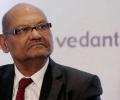
With a robust outlook for mineral-led growth in India, Anil Agarwal-led Vedanta Limited is looking to invest up to $20 billion across its businesses, which includes doubling of silver production and steel capacities. In a virtual press conference had last month, Agarwal said the company planned a capex of $5 billion over a period of three years. The company has not given a timeline for $20-billion investment.

Beating rivals like China Metallurgical and Xstrata, Vedanta Resources on Monday said it has finalised a deal with the London-based Anglo American's entire zinc business in Ireland and Africa for $1.34 billion deal.

The mining ministry's inordinate delay in giving approval to group firm Hindustan Zinc to buy London-based Anglo American's zinc mines has forced the company to route it through Sterlite.

Aluminum major Vedanta's $1.34-billion acquisition of the zinc assets of Anglo American, which will be funded through Hindustan Zinc, is the latest manifestation of the restored growth appetite of Indian companies.
The group also has plans to spend Rs 50,000 crore (Rs 500 billion) on power generation. The London-listed giant will spend Rs 43,000 crore (Rs 430 billion) to enhance its capacity, in addition to its Rs 50,000-crore (Rs 500-billion) plan in power generation.
Hindustan Zinc (HZL), a subsidiary of Vedanta, announced an interim dividend of Rs 21 per share last week, resulting in an outflow of Rs 8,863 crore. The announcement has turned the spotlight on India Inc's dividend-paying policy - more so for reasons driving the generosity of firms. An analysis of BSE 500 companies by Business Standard Research Bureau shows that some of the top 20 dividend-paying companies in 2021-22 (FY22) include Vedanta, Tata Consultancy Services, HZL, Oil and Natural Gas Corporation (ONGC), Indian Oil Corporation (IndianOil), Hindustan Unilever (HUL), Reliance Industries (RIL), and Bajaj Auto, among others.
Base metals have recorded a sharp rise in prices as global demand picks up. Rising alongside are the share prices of the leading metal companies in the country like Sterlite, National Aluminium Company and Hindustan Zinc.
Vedanta Resources chairman Anil Agarwal on Thursday said he is ready with Rs 8,000 crore (Rs 80 billion) for buying the government's residual equity in Balco and Hindustan Zinc, for which he will meet the Finance Minister this month.
The decision was taken by the ministry this week, a top Coal Ministry official said, while refusing to reveal the names of the companies.

With the new owner shelling out Rs 18,000 crore for the buyout of 'Maharaja' this would be the highest ever amount garnered through privatisation or even the cumulative sum garnered through strategic sale in 1999-00 to 2003-04. The government had garnered roughly over Rs 5,000 crore during that five-year period by privatising 10 CPSEs.
Steel Authority of India Ltd is poised to outpace its metal sector rivals, including private players giants like Tata Steel and Hindustan Zinc on the stock market radar going forward, the analysts believe.\n
Sterlite had acquired a 51 per cent stake in unlisted Balco as part of the government's strategic sale of its shareholding in March 2001 for Rs 551.50 crore (Rs 5.51 billion).
To script India's biggest overseas copper mine buy.
To script India's biggest overseas copper mine buy.

After a hiatus of nearly two decades, the government's programme to privatise state-owned firms restarted with the handing over of debt-laden national carrier Air India to the Tata Group. With the new owner shelling out Rs 18,000 crore for the buyout of the 'Maharaja', this would be the highest-ever amount garnered through privatisation, and is even more than the cumulative sum mopped up through strategic sales from 1999-00 to 2003-04. The government had in October last year inked the share purchase agreement with the Tata Group for sale of national carrier Air India for Rs 18,000 crore. Tatas would pay Rs 2,700 crore cash and take over Rs 15,300 crore of the airline's debt.
To avoid Balco-like situation, the government plans to take the market route to off-load 13 per cent of of the 29 per cent shares it holds in Hindustan Zinc Limited.
Anil Agarwal, chairman and managing director, Sterlite Industries speaks on his future plans.
Tata Power, Sesa Sterlite and Hindustan Zinc likely to be hit.
The share of public sector undertakings (PSUs) in the total market capitalisation of listed companies--at an all-time low of 10 per cent currently --- may get a leg-up from the government's divestment push. Recently the government announced the successful sale of national carrier Air India to Tata Sons, India's first privatisation of a PSU since 2002-03. The transaction is expected to be completed by December.

Anil Agarwal, chairman of the Vedanta group, has not started the New Year on a good note.

The company no longer sees the London listing as necessary to access capital and the deal will simplify Vedanta's corporate structure.

Analysts refuse to read too much into the early birds numbers.
